

I remember the exact night I stopped counting the days. It was somewhere past forty, and I’d been marking them on a note in my phone like a woman keeping score in a game nobody told her she was losing.
We weren’t fighting. That’s the part nobody warns you about. There was no affair, no big blowup, no slammed doors. Just two people who used to reach for each other in bed, now lying six inches apart like strangers sharing a hotel room.
He’d come home, kiss me on the forehead like I was his aunt, and disappear into his phone. I’d ask how his day was. He’d say “fine.” I’d tell myself this was just a season. Kids, work, exhaustion. Every marriage goes through it.
Except every marriage doesn’t come back from it. And some part of me knew that.
The Slow Disappearing Act
I did everything the magazines tell you to do. I planned a date night — he fell asleep during the movie. I bought lingerie I never got to wear because by the time I put it on, he was already asleep. I tried talking about it, gently, the way you’re supposed to: “I miss us.” He said, “I miss us too,” and then nothing changed. Not one thing.
So I did what a lot of women do. I shrank. I stopped initiating because rejection, even the quiet kind, is its own specific humiliation. I told myself I was being patient. Understanding. Low-maintenance. I was, in my own head, being the “good wife” — the one who doesn’t nag, doesn’t pressure, doesn’t make a big deal out of it.
What I was actually doing was disappearing in plain sight.
The lowest moment came on our anniversary. I’d made a reservation, bought a dress, done my hair. He forgot. Not maliciously, he was just that far gone, that checked out. I sat in the restaurant alone for twenty minutes before I canceled the table and drove home crying, wondering when exactly I became someone my own husband could forget.
That night I didn’t Google “how to spice up your marriage” for the fortieth time. I Googled something more honest: why does he act like he doesn’t want me anymore, and how do I get him to want me the way he used to.
That’s how I found PairGrow.

Not Another Listicle About Candles and Lingerie
I’ll admit, I almost closed the tab. I’d read every “10 ways to reignite the spark” article on the internet, and none of them worked because none of them explained why the spark had gone out in the first place. They treated intimacy like a mood you could set with the right playlist.
PairGrow didn’t talk about mood. It talked about mechanisms, the actual psychological and physiological patterns that shut intimacy down between two people who still love each other. Things like Attachment Drift, the Emotional Safety Ceiling, and what they call the Familiarity Flatline — the point where a partner becomes so predictable, so “always there,” that the nervous system stops registering them as someone to be desired at all.
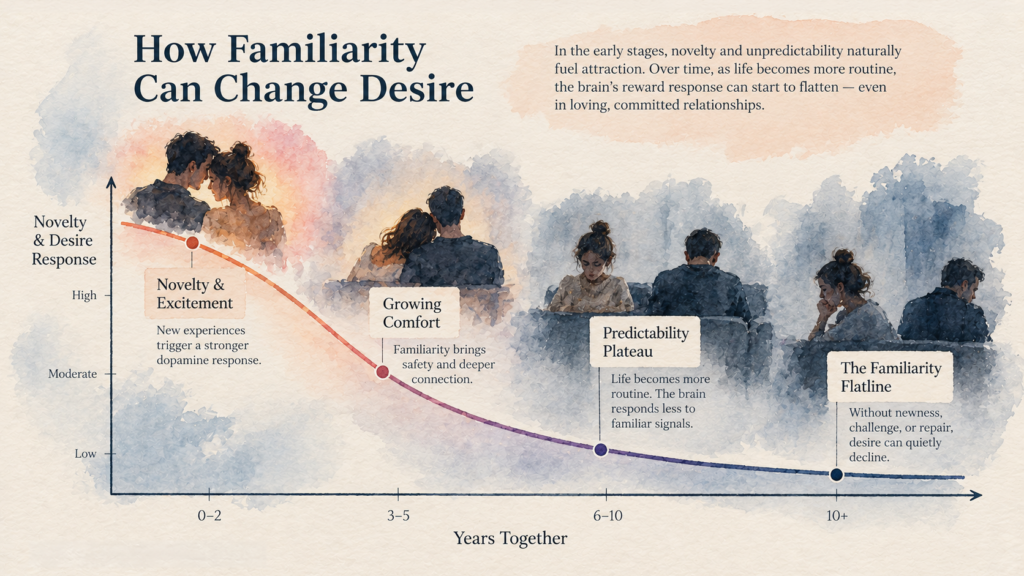
The app frames this around the idea of habituation: the well-documented tendency for the brain’s reward response to any repeated, unchanging stimulus to flatten out over time. Novelty and unpredictability are tied to dopamine response; routine, however loving, doesn’t trigger it the same way. PairGrow’s pitch is that this isn’t a character flaw in either partner, it’s neurochemistry doing what it’s built to do, left unmanaged.
It broke this down into three checkpoints it says most couples hit before things go quiet:
- Predictability plateau — affection becomes so reliably available that the brain stops flagging it as significant.
- Repair debt — small ruptures (a snapped comment, a canceled plan) go unresolved and quietly accumulate, dulling emotional safety instead of protecting it.
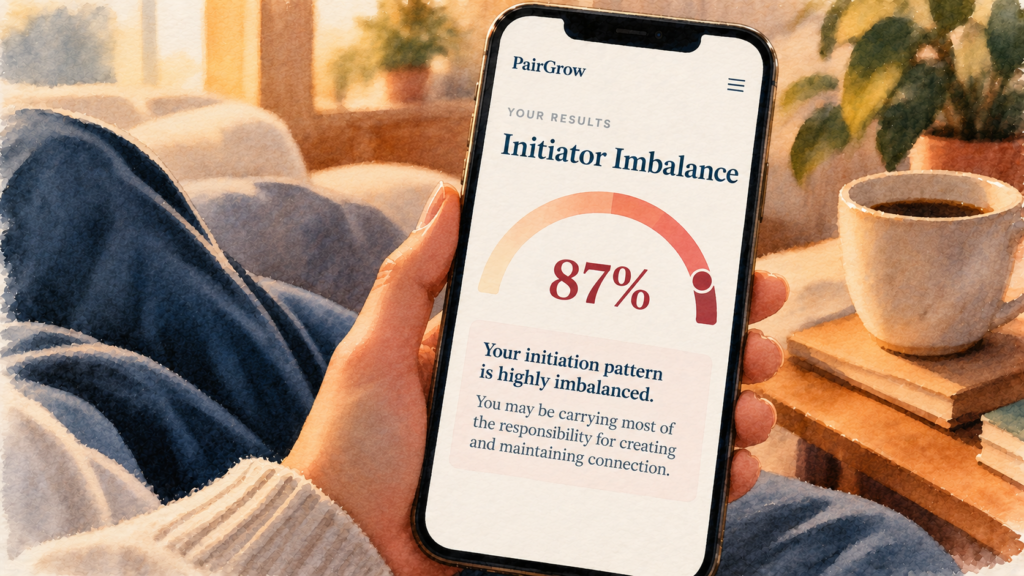
- Initiator imbalance — one partner ends up doing 80–90% of the emotional and physical initiating, which research on relationship dynamics associates with steadily declining desire in the partner who’s chased.
I took their Intimacy & Connection Assessment at midnight, half-convinced it would tell me what I already knew: that we’d just grown apart. Instead, it asked about things no quiz had ever asked: how we repaired after conflict, who initiated affection and how often, whether I filled emotional gaps for both of us without realizing it.
The results were uncomfortable in the way truth usually is. It turned out that by being endlessly agreeable, endlessly patient, endlessly there, I had unintentionally made myself safe to the point of being invisible. His brain wasn’t chasing anything anymore, because there was nothing left to chase. I hadn’t lost his desire. I had quietly trained it out of him.
What Actually Changed
PairGrow didn’t give me a script to recite or a game to play. It gave me a structured, week-by-week plan built around restoring what they call “the pull”, the specific emotional and behavioral rhythm that makes a partner re-engage instead of coast. It wasn’t about being colder or playing hard to get. It was about rebuilding a version of myself he had to actually notice again, not perform for him, but return to for myself, in a way that happened to make me magnetic again as a side effect.
Some of it was uncomfortable to do. Pulling back on being the one who smoothed everything over. Letting a silence sit instead of rushing to fill it. Reintroducing a little unpredictability into a routine that had gone stale for both of us.
Three weeks in, he initiated a real conversation for the first time in months, not about logistics, about us. Five weeks in, he reached for me first, for the first time in almost a year, and it didn’t feel like an obligation. It felt like being seen again.
We’re not “fixed” in some fairy-tale sense. But we’re two people who are actually reaching for each other again, instead of just occupying the same house.

If You’re Reading This at Midnight, Marking the Days
If you’re the woman lying six inches away from someone you love, wondering when exactly you became a roommate instead of a partner, I want you to know this isn’t about being more patient, more understanding, or more anything. Patience isn’t what got us here. Understanding what was actually happening underneath the silence is.
PairGrow’s assessment takes about three minutes. It won’t tell you your marriage is over, and it won’t tell you to just “give it time.” It’ll show you, specifically, what’s driving the distance in your relationship — and the exact pattern that can bring the pull back.
You already know waiting hasn’t worked. Three minutes might tell you what will.

Okay, this hit a little too close to home.
The ‘six inches apart’ part… yep.
I never thought of it this way.
The anniversary part actually hurt.
Why does this feel like my marriage?
I’m definitely taking that quiz.
The silence is honestly the worst part.
This made me rethink what’s happening between us.