
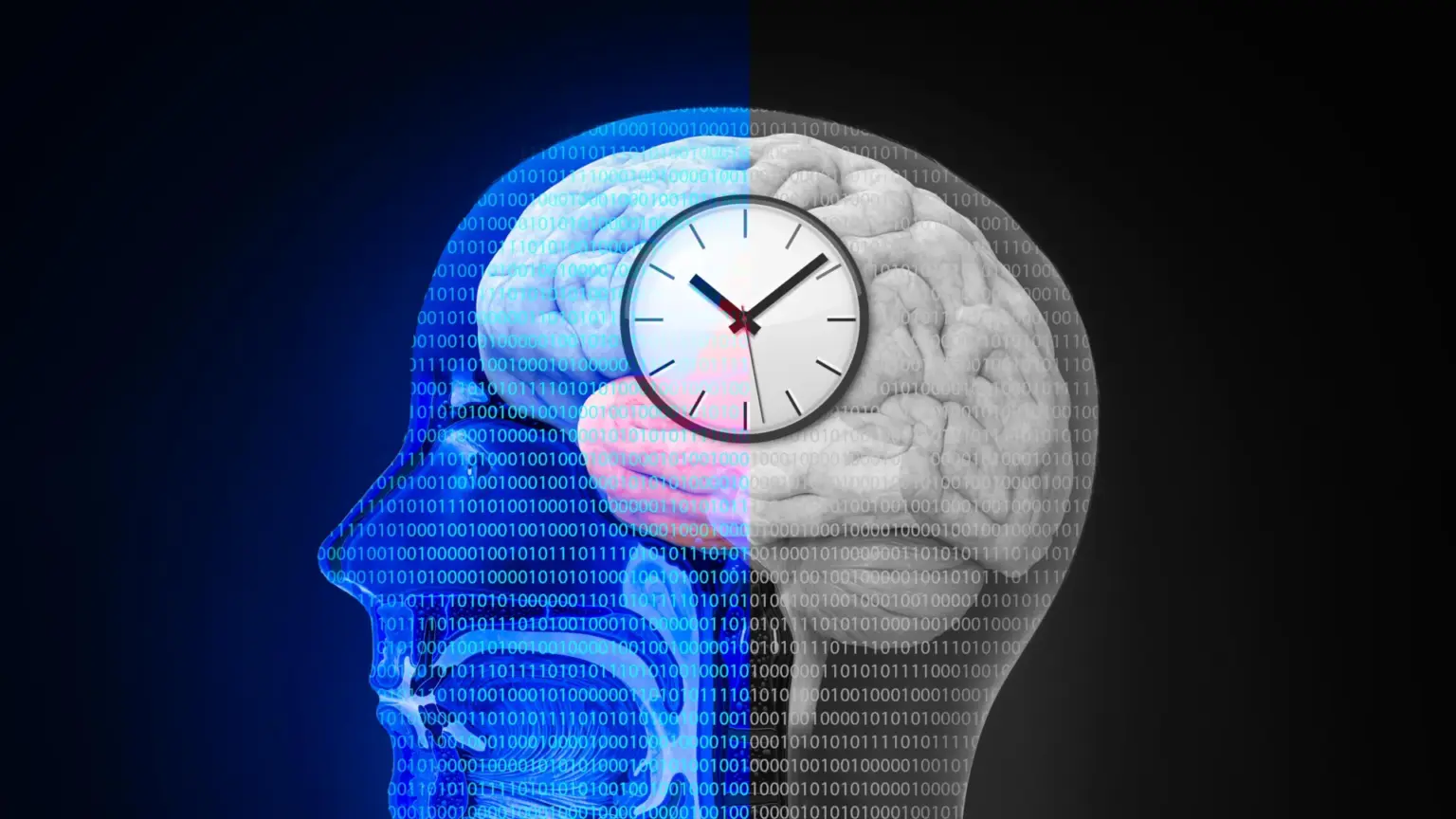
The human brain is constantly working, but it does not handle all information at the same speed. Some signals require instant reactions to what is happening around us, while others develop more slowly as we interpret meaning, context, and other people’s intentions.
A new study from Rutgers Health, published in Nature Communications, examines how the brain blends these fast and slow streams of information. The researchers focused on how white matter pathways—the wiring that links brain regions—support communication across the brain and help shape thinking, decision-making, and behavior.
Different Brain Areas Operate on Different Internal Timelines
Not every part of the brain processes information in the same way or at the same pace. Each region tends to work within a characteristic time window, known as intrinsic neural timescales (INTs). In simple terms, these timescales reflect how long a brain region retains incoming information before updating to the next signal.
According to the study’s senior author, Linden Parkes, an assistant professor of psychiatry at Rutgers Health, effective behavior depends on combining information that is processed over multiple timescales. The brain, the team argues, accomplishes this by using its white matter connections to share and integrate information across regions.
Brain Connectomes From Nearly 1,000 People
To investigate how this integration happens, the scientists analyzed brain imaging data from 960 individuals. From these scans, they built detailed maps of each person’s brain connections—often called connectomes. They then applied mathematical models used to describe how complex systems evolve over time, allowing them to simulate how information flows through these brain networks.
Parkes said this approach creates a direct link between local processing in specific regions and how that processing is distributed across the brain to support behavior.
Why Timing Patterns May Affect Cognitive Ability
The team found that the way neural timescales are arranged across the cerebral cortex appears to influence how efficiently the brain can shift between large-scale activity patterns associated with behavior. Importantly, these timing patterns differed from person to person.
The researchers reported that these differences in how the brain handles information at multiple speeds may help explain variation in cognitive abilities. They also found connections between timing patterns and genetic, molecular, and cellular properties of brain tissue, linking the results to underlying biology.
Similar relationships were observed in mouse brain data, suggesting that these timing mechanisms may be shared across species.
Potential Relevance for Mental Health
The researchers are now extending the same methods to conditions such as schizophrenia, bipolar disorder, and depression. Their aim is to understand whether changes in connectivity disrupt how the brain processes information over time, potentially contributing to symptoms.
The work was carried out with collaborators including Avram Holmes of Rutgers and Jason Z. Kim of Cornell University, along with postdoctoral researchers Ahmad Beyh and Amber Howell.
