
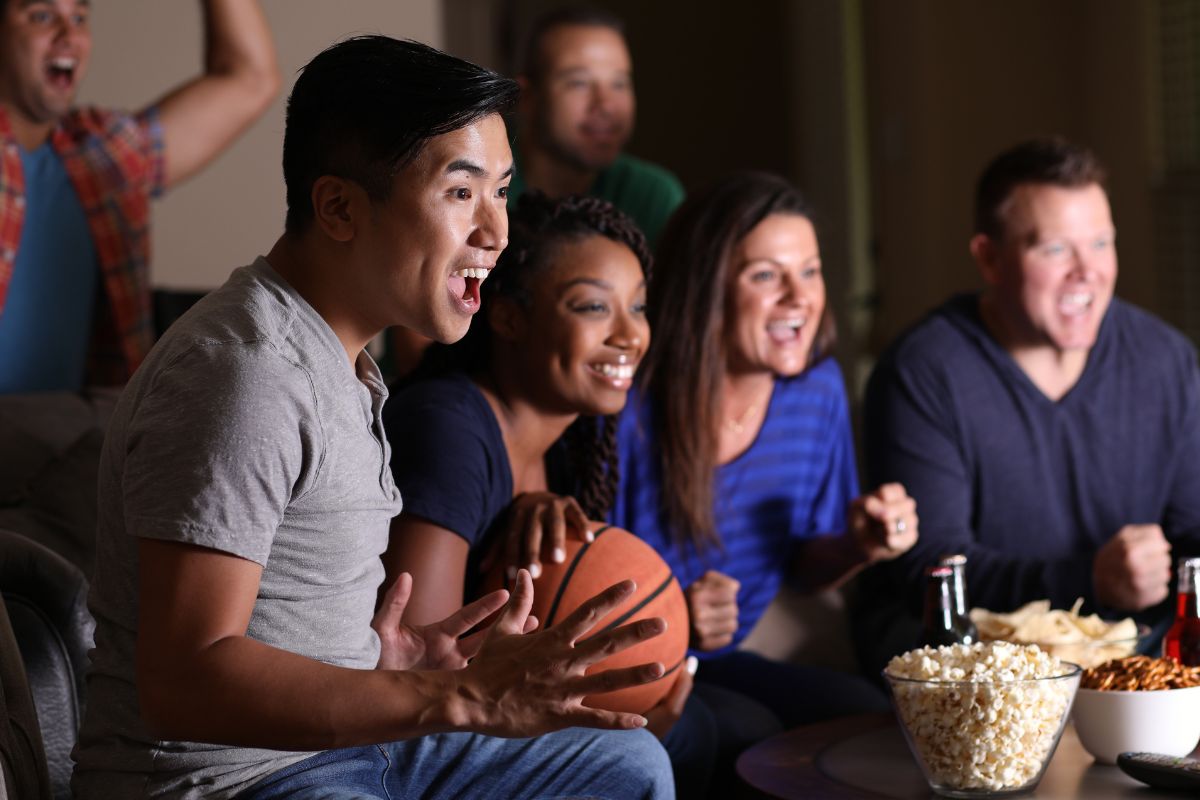
Watching live sports may do more than entertain. New research suggests that sharing the emotional highs and lows of a game can influence the body in measurable ways, helping spectators become more synchronized both emotionally and physiologically.
The study, published in Psychology of Sport & Exercise, found that people attending a live basketball game showed changes in hormones linked to bonding and stress, while their heart rhythms became increasingly similar as the match unfolded. The findings suggest that shared sporting experiences may foster a temporary sense of connection that extends beyond simple excitement over the result.
Inside the Basketball Study
Researchers followed 60 adults, including 21 women, who attended live university basketball games. Rather than being highly devoted fans, participants were mostly occasional spectators, making the setting similar to a typical visit to a local sporting event.
Saliva samples were collected before the game, during halftime, and after the final buzzer to measure levels of oxytocin and cortisol. Throughout the event, participants also wore sensors that continuously recorded heart activity. They additionally completed questionnaires assessing enjoyment, engagement, feelings of unity with others, and their willingness to attend similar events in the future.
Oxytocin is commonly associated with social bonding, trust, and empathy, although scientists recognize that its effects are more complex than the popular description of a “bonding hormone” suggests. Participants who began the event with relatively low oxytocin levels experienced an increase during the game, while those with initially higher levels maintained elevated concentrations throughout the event.
Cortisol, one of the body’s primary stress hormones, showed the opposite pattern. On average, cortisol levels declined as the game progressed, suggesting that participating in a shared social experience may reduce stress despite the emotional tension created by the competition.
Spectators’ Hearts Began to Synchronize
One of the most striking findings involved participants’ heart rhythms.
As the game unfolded, heart-rate patterns among different spectators became increasingly similar, a phenomenon known as physiological synchrony. This synchronization remained detectable even after the game had ended.
Higher oxytocin levels were modestly associated with stronger heart-rate synchrony. Although spectators did not literally function as a single organism, they frequently responded together to dramatic moments such as important plays, controversial fouls, and last-second shots. When the crowd reacted simultaneously, their physiological responses often aligned as well.
Researchers note that this type of synchronization can occur even among strangers who never speak to one another. Human biology appears well suited to situations in which many people focus on the same event while experiencing similar emotions at the same time.
Participants who displayed stronger physiological synchrony and higher oxytocin levels also reported greater enjoyment, stronger engagement, a deeper sense of unity with fellow spectators, and a greater desire to attend future sporting events.
Why Watching in a Stadium Feels Different
Although television broadcasts offer detailed camera angles, slow-motion replays, and statistical analysis, they cannot fully recreate the social atmosphere of a live crowd.
Inside an arena, emotions spread rapidly. One person stands to celebrate, nearby spectators follow, and within seconds thousands of people may be reacting together. Cheers, applause, chants, and collective moments of anticipation create an environment that encourages shared emotional experiences.
In these situations, the distinction between individual emotion and group behavior becomes less pronounced as spectators briefly experience themselves as part of a larger community united by the same unfolding story.
Previous research has also linked attending live sporting events with greater life satisfaction, a stronger sense of purpose, and lower levels of loneliness. One large study involving 7,209 adults in England reported these associations even after accounting for factors including age, health, employment, and financial circumstances.
Another study involving 885 adults in China suggested that the social aspects of attending sporting events may contribute more to well-being than the outcome of the competition itself. Sharing conversations before the game, watching alongside others, and feeling part of a community appeared to matter more than simply experiencing victory or defeat.
What the Study Cannot Show
The researchers caution against drawing overly broad conclusions from their findings.
The basketball study included only 60 participants, observed just two games, and measured responses during a single event. These limitations mean the results cannot yet be generalized to all sporting events or populations.
The researchers also did not compare spectators in the arena with people watching the same game at home or attending other social gatherings such as concerts or community events. As a result, the study cannot determine whether the observed effects were produced specifically by sports or by shared social experiences more generally.
For the same reason, the findings should not be interpreted as evidence that attending sporting events can replace professional treatment for mental health conditions such as depression or anxiety.
The Value of Shared Experiences
Even so, researchers suggest that sporting events may provide a natural setting for social connection, particularly for people who find casual social interaction difficult. The game itself offers a shared focus of attention, making interactions feel more natural and less forced.
At a time when much of social life takes place through messages, social media, and digital communication, live sporting events offer an opportunity for people to gather physically and experience the same emotions together.
For a few hours, strangers sit side by side, celebrate the same successes, share the same disappointments, and often begin referring to the team as “we.” A dramatic goal or a game-winning shot can prompt spontaneous high-fives, cheers, or embraces between people who have never met before.
Scientists are only beginning to measure the biological processes behind an experience that many sports fans have long recognized intuitively. The findings suggest that simply sharing the same moment, focusing on the same event, and experiencing the same emotions may temporarily bring people together in ways that extend beyond psychology and into human physiology.
